Is It Legal to Put an ADU in Orlando?
Yes—inside City of Orlando limits, most single-family lots can add a detached ADU by-right if setbacks and size rules are met. Mailing address Orlando is not enough; unincorporated Orange County is a different path.
Florida roundup
Top 21 Florida communities
Our complete curated list with regional groupings and links to every directory profile.
Read the roundupOpen state map →In Florida
Related reads
- → City of Orlando vs. Unincorporated County: Which Rules Apply to You?
Legal & Permitting · Orange County
- → The \"Special Exception\" Reality: Navigating Orange County Zoning Laws
Legal & Permitting · Orange County
- → What is an ADU? Understanding Your Florida Backyard Housing Options
Legal & Permitting · Florida housing
Florida community map
Visualize clusters and compare regions before you shortlist profiles.
Open map →Short answer: If your parcel is inside City of Orlando corporate limits, a detached Accessory Dwelling Unit (ADU) is generally legal by-right in most single-family residential zones—no public hearing required when your site plan meets setback, height, and size rules. If your tax bill says unincorporated Orange County, the same backyard cottage is usually not by-right; you often need a Special Exception from the Board of Zoning Adjustment (BZA).
Thousands of Central Florida homeowners have an Orlando mailing address but are governed by the county, not the city. Before you order plans or sign with a builder, confirm jurisdiction on the Orange County Property Appraiser (OCPA) parcel lookup.
What counts as an ADU in Orlando?
An ADU is a secondary dwelling on the same lot as a primary single-family home, with its own sleeping area, bathroom, and full kitchen, built on a permanent foundation and permitted under the Florida Building Code.
That definition matters because:
- A tiny home on wheels (THOW) parked in a driveway is not an ADU—it is usually treated as an RV or temporary structure unless a specific ordinance allows long-term occupancy (rare on standard residential lots).
- A prefabricated modular unit on a permanent foundation can be an ADU if zoning and building permits approve it.
For the full taxonomy, see What is an ADU in Florida?. If your goal is community living instead of a backyard build, browse Florida tiny home communities—a different legal lane entirely.
City of Orlando: when an ADU is allowed by-right
Inside city limits, Orlando has leaned into ADUs as infill housing. In eligible single-family zones, a compliant detached ADU is typically an administrative permit—staff review only.
Common requirements (verify on your zoning district):
| Topic | Typical City of Orlando approach |
|---|---|
| Approval path | By-right (no BZA hearing) when standards are met |
| Placement | Side or rear yard; cannot sit closer to the street than the main house |
| Rear setback | Often ~5 feet for a single-story detached unit |
| Side setback | Often ~5 feet for standard configurations |
| Owner occupancy | Historically required on one of the two units—confirm current code text |
| Utilities | Dedicated connections to water, sewer/septic, and electric |
Dimensional tables change. Always pull your zoning district from the city GIS and match it to the current municipal code before budgeting.
When “Orlando” on your mail is actually Orange County
If OCPA shows Unincorporated Orange County (not City of Orlando), you are on the county rulebook—not the city’s by-right ADU path.
In most county residential zones (R-1, R-1A, etc.), a detached backyard home with a full kitchen typically requires a Special Exception: neighbor notification, yard signs, and a public BZA hearing. That adds months and uncertainty compared to city by-right approval.
Our deep dive: City of Orlando vs. unincorporated Orange County.
Practical split:
- College Park, Baldwin Park, Delaney Park, Thornton Park, Lake Eola Heights (city addresses) → often city path.
- Winter Park, Apopka, Maitland → separate municipalities entirely (not covered here).
- Large suburban tracts west and south of the urban core → frequently county despite “Orlando, FL” on USPS labels.
Steps before you assume “yes, legal”
- Confirm jurisdiction on OCPA (Tax District / Municipality field).
- Pull zoning and lot coverage—will the ADU exceed impervious limits?
- Check utilities—sewer lateral depth, septic capacity, panel size (see Florida ADU Starter Kit checklists).
- Choose housing lane—backyard ADU vs. tiny home village vs. THOW (usually not a backyard ADU substitute).
Run these in order in 7 steps to a legal backyard home.
Orlando ADU vs. living in a tiny home community
| Path | Best for | Legal anchor |
|---|---|---|
| Detached ADU on your lot | Rental income, family suite, equity on land you already own | City/county zoning + building permit + CO |
| Long-term lease in a tiny village | Move fast without a construction timeline | Operator land use + RVIA/NOAH-certified unit rules |
| THOW in a backyard | Usually not a durable legal strategy | Code enforcement risk on standard SF lots |
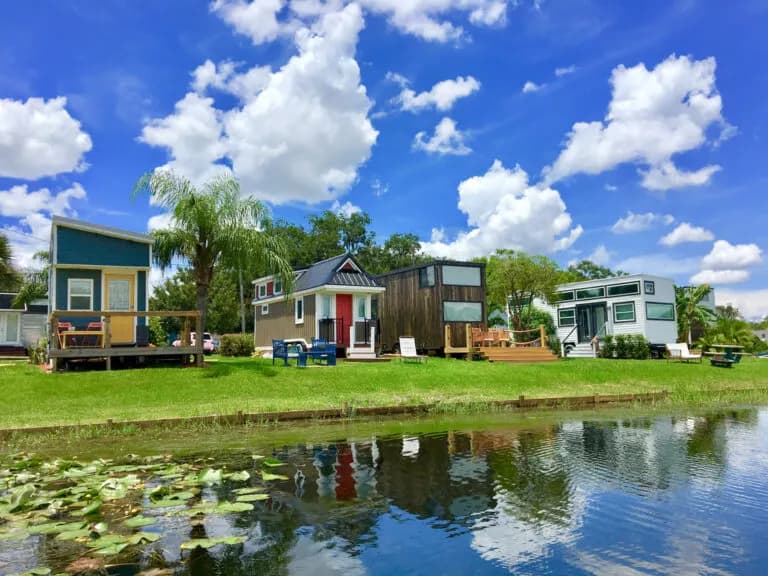
Orlando’s flagship village profile: Tiny Town Orlando on Lake Fairview—useful if you want lakeside community living while you research whether an ADU on owned land pencil out.
FAQ
Do I need a hearing to build an ADU in Orlando? Only if you are inside City of Orlando limits and meet by-right standards—typically no. Unincorporated Orange County usually yes (Special Exception).
Can I rent the ADU on Airbnb? City and county short-term rental (STR) rules are separate from ADU legality. Confirm STR registration requirements before you model income.
How big can an Orlando ADU be? Caps depend on zoning district and primary dwelling size. Verify maximum floor area in the current code—do not rely on blog summaries for entitlement math.
Is a prefab modular unit legal? Yes, when it is permitted, inspected, and on a permanent foundation—same as site-built.
This article is educational, not legal advice. Zoning and building codes change; confirm with City of Orlando Development Services or Orange County Planning & Zoning before you commit.
Next steps: Compare Orlando vs. county rules · Download the Florida ADU Starter Kit · Free site snapshot for your address · Browse all Florida tiny home communities
Check your Florida address for free
Run the buildability chat for flood, wetlands, soils, and local contacts—then request a full Land Feasibility Report if you want parcel-level zoning.
Free site snapshot